Turo and Tesla Take the Next Step Toward Autonomous Car Rentals
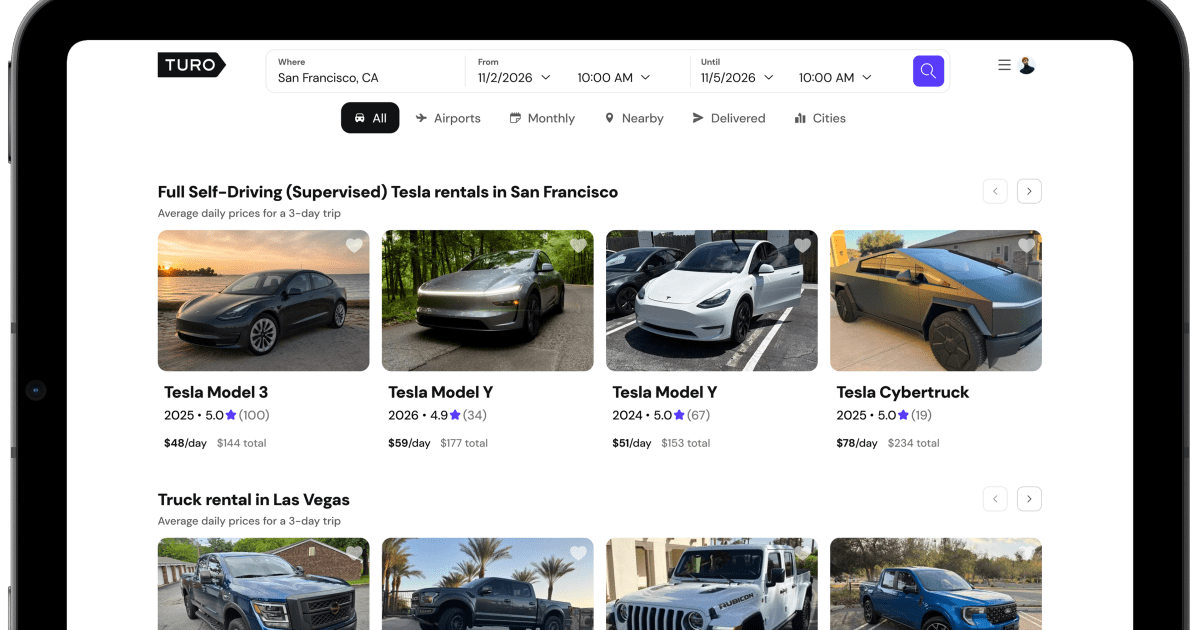
Turo and Tesla are bringing supervised self-driving technology to car rental, marking another step in the transportation industry's gradual move toward autonomous vehicles.
Beginning October 28, Turo customers in the U.S. will be able to identify and rent Tesla vehicles equipped with Full Self-Driving (Supervised), or FSD, through the carsharing marketplace.
The vehicles aren't autonomous. Drivers must remain attentive and ready to intervene. But the partnership gives more consumers an opportunity to experience advanced driving automation without owning a Tesla.
For the rental industry, the rollout also raises a familiar challenge: helping customers use unfamiliar vehicle technology safely.
Earlier Steps Toward Autonomous Rentals
Turo and Tesla aren't the first companies to explore how advanced driving technology could change car rental.
In Las Vegas, Halo.Car began delivering remotely operated rental vehicles without onboard safety drivers in 2023. Vay introduced a similar commercial service in January 2024.
In both cases, remote human operators drove vehicles to customers, who then took control and drove them conventionally. The vehicles could also be retrieved remotely after the rental.
Neither service was fully autonomous. But both demonstrated how driving technology could change the rental experience before driverless vehicles became commercially viable.
The Turo-Tesla partnership takes a different approach. Rather than using remote operation to deliver the vehicle, it makes advanced driving assistance available to renters during their trips.
How Turo's FSD Rentals Will Work
In an interview with Auto Rental News, Tim Rossanis, senior vice president at Turo, said thousands of FSD-enabled Teslas are currently available on Turo.
Not all those vehicles necessarily have an active FSD subscription. Turo will verify which vehicles have the feature enabled through a direct connection with Tesla's systems.
The rollout will be nationwide, with expansion to Canada and Australia planned later.
Rossanis said customers were already contacting Tesla hosts to ask whether their vehicles had FSD. Some wanted to rent a Tesla specifically to try the technology.
“If you came to Turo, you'd have to go through the booking flow and message the host and confirm the booking and then message the host and say, does this vehicle have FSD?” Rossanis said.
The partnership eliminates that uncertainty by allowing customers to identify FSD-equipped vehicles before booking.
“[It] became abundantly clear that this is something the industry was missing,” Rossanis said. “The ability to actually very clearly verify the status of the driver-assisted technology that an OEM offers.”
Hosts without active FSD subscriptions can enable the feature to participate. Hosts control their own rental rates. Turo does not impose an additional platform-level charge for FSD rentals.
The Renter Education Challenge
The rental industry has already experienced the difficulties of introducing unfamiliar vehicle technology.
As rental companies expanded their EV fleets, customer education became a stumbling block. Renters unfamiliar with EVs needed to understand charging procedures, range limitations, and how EVs operate differently.
FSD presents a different challenge, with potentially greater safety implications. Tesla's system can steer, accelerate, brake, and navigate driving situations, but the driver must remain attentive and ready to take control.
Rossanis suggested that FSD is relatively intuitive once activated because the vehicle performs the driving tasks. He also recalled that having someone explain the system was helpful when he first used it.
Turo renters will have access to Tesla instructional materials, including a tutorial video. Hosts can also answer questions and help customers become familiar with the technology.
However, unlike a traditional rental counter, where an employee can explain vehicle features during the handoff, Turo rentals often involve contactless pickup. That means much of the instruction must happen remotely, even when the host has firsthand experience with FSD.
With FSD, understanding how to activate the system is only part of the equation. Renters must also recognize its limitations and know when to intervene.
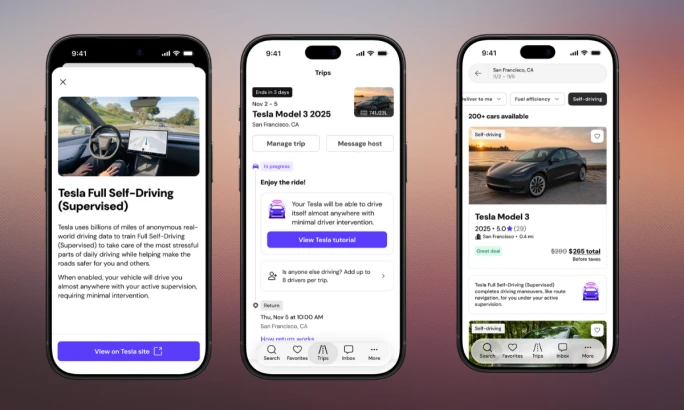
The Turo app allows renters to search for Tesla vehicles equipped with Full Self-Driving (Supervised), verify the feature's availability before booking, and access Tesla instructional materials during their rental.
Tesla
Insurance and Responsibility
Rossanis said Turo is not introducing a separate insurance or protection arrangement for FSD-equipped vehicles.
The platform's existing protection structure applies, and the renter remains responsible for operating the vehicle safely, including when FSD is engaged.
That distinction separates supervised driving assistance from fully autonomous operation, which would introduce substantially different questions about responsibility and liability.
Renters Can Now Choose a Car for Its Tech
FSD gives Turo hosts another way to distinguish their vehicles beyond make, model, or price. The partnership also demonstrates how software-enabled features could become part of the rental selection process.
Traditionally, renters have chosen vehicles primarily by category or model. As automakers introduce more advanced software features, customers may increasingly want to know what a particular vehicle can do.
Rossanis pointed to Turo's broad inventory as an advantage.
“We've got 1,500 makes or models available on the platform globally,” he said, explaining that customers can select specific vehicles rather than simply a vehicle class.
Traditional rental companies could pursue similar integrations with automakers, although their fleet structures and booking models differ from Turo’s.
For Turo, the immediate opportunity is to make FSD a recognizable feature that customers can seek out. The longer-term question is whether other software-defined capabilities will influence rental decisions in the same way.